Go-to-Goal Autonomous Mobile Robot
Arduino · MPU6050 · Polar Coordinate Control · Cascaded PID · Bluetooth
Autonomous differential-drive robot navigating to Bluetooth-specified XY coordinates using dead-reckoning, MPU6050 IMU, encoder feedback, and a cascaded Polar Coordinate + PID controller for smooth multi-waypoint trajectories.
3D Model — Interactive
Project Objective
Develop an autonomous differential-drive mobile robot capable of navigating to user-defined XY coordinates and sequential waypoints using onboard odometry, inertial sensing, and closed-loop control — without external localisation infrastructure.
Navigation Strategy & Motion Logic
The initial navigation framework used a geometry-based turn-and-move approach where the robot calculated the required heading angle and Euclidean distance to the target coordinate. The robot first aligned itself toward the target heading, translated linearly, and then repeated the sequence for subsequent waypoints.
- →Coordinate input received wirelessly through HC-05 Bluetooth communication
- →Geometric heading calculation using inverse tangent relations
- →Sequential Turn → Move → Correct workflow for waypoint traversal
- →Distance estimation from wheel encoder pulse integration
- →Origin referenced at (0,0) with incremental pose updates
Polar Coordinate Control Architecture
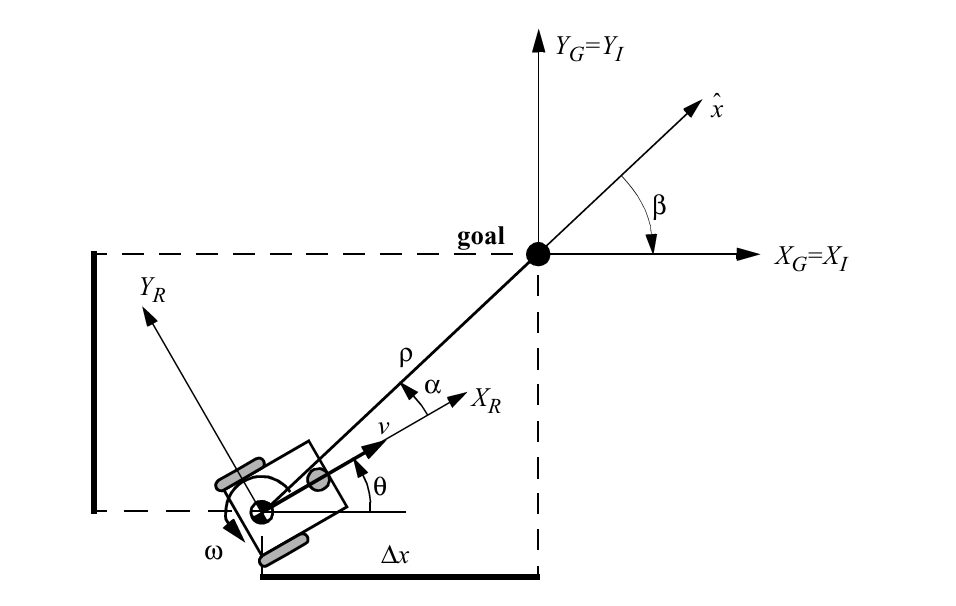
The navigation system was later upgraded to a continuous polar-coordinate control architecture for smoother and more stable trajectory generation. The controller computes translational distance error (ρ) and heading error (α) relative to the target, enabling simultaneous orientation correction and forward motion instead of discrete stop-and-turn behaviour.
- →Polar coordinate navigation using distance (ρ) and heading error (α)
- →Continuous heading correction during translational motion
- →Reduced oscillation and smoother trajectory convergence
- →Improved waypoint transition without abrupt stopping
- →Real-time pose estimation from encoder and IMU feedback fusion
Closed-Loop Control & Sensor Fusion
A cascaded feedback control system combines wheel encoder odometry with MPU6050 inertial feedback to minimise heading drift and maintain stable trajectory tracking. PID-based correction dynamically compensates for wheel mismatch, surface disturbances, and orientation errors during motion.
- →Quadrature encoder feedback for wheel velocity and displacement estimation
- →MPU6050 gyroscope integration for yaw stabilisation
- →PID heading correction for straight-line trajectory maintenance
- →Differential wheel velocity correction during turning manoeuvres
- →Real-time sensor fusion for robust pose estimation
Mechanical & Electronic System Design
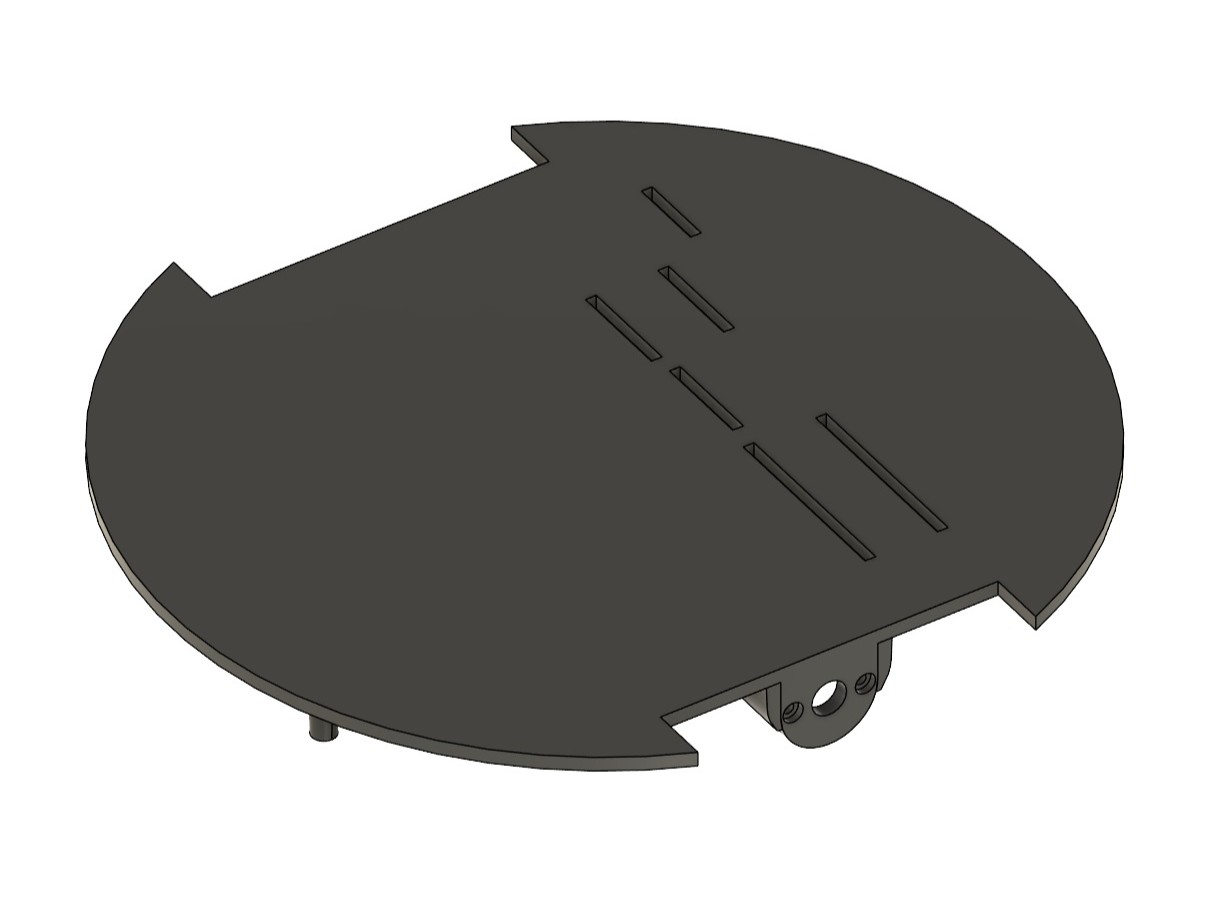
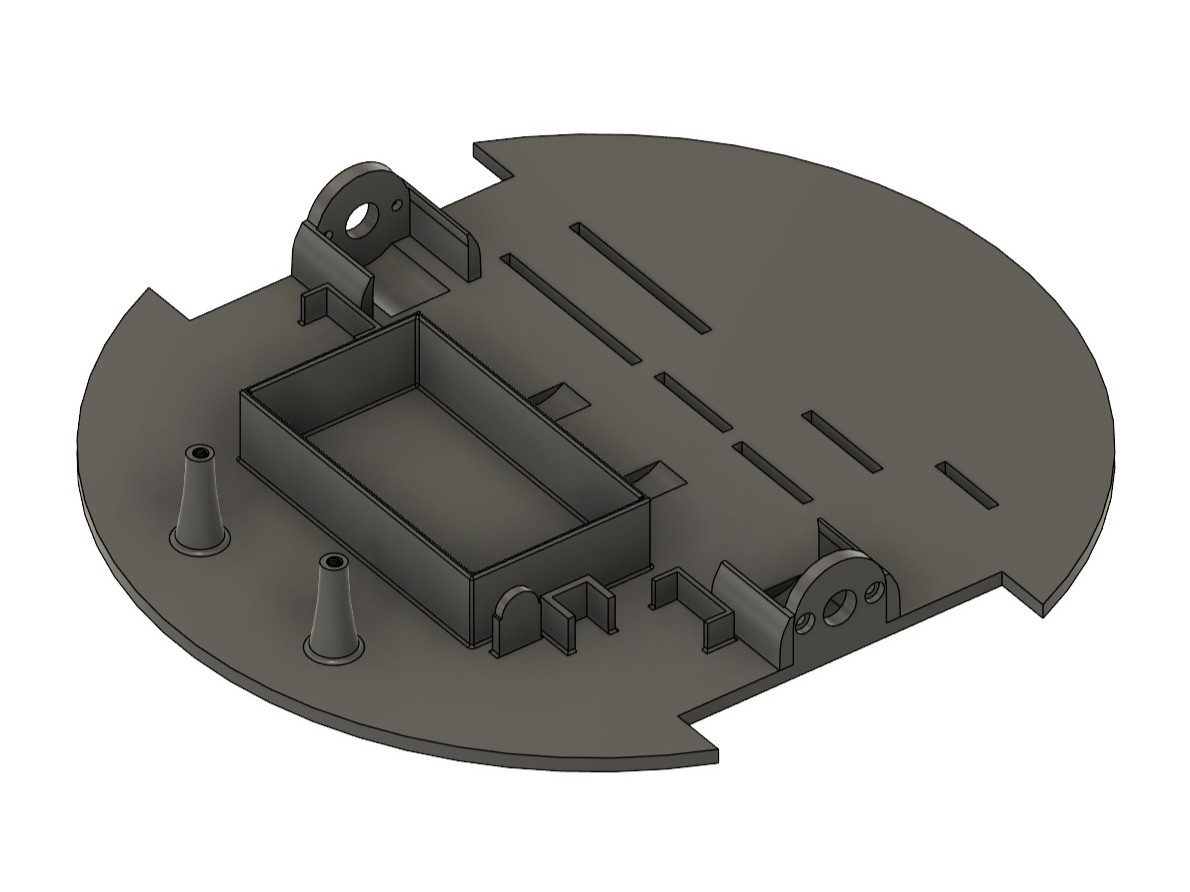
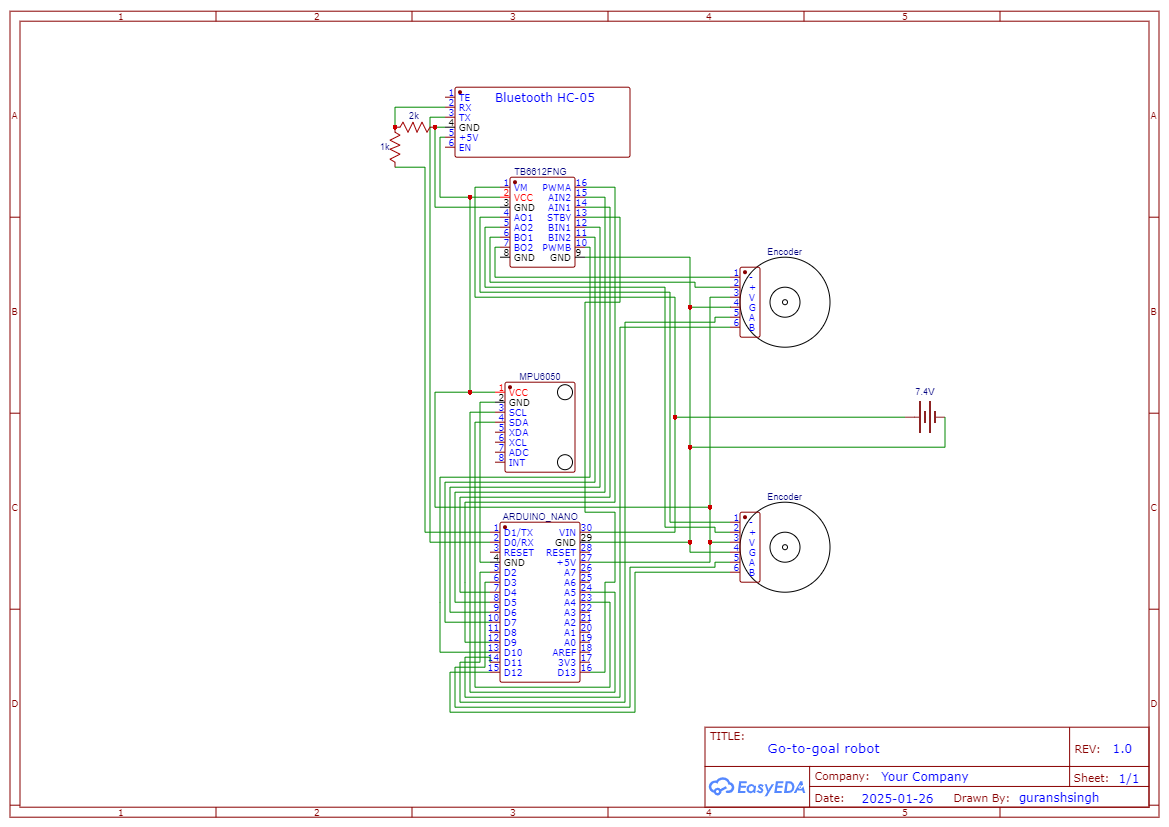
The robot utilises a custom designed 3D printed chassis housing a compact differential-drive architecture. The robot is powered by encoder-equipped N20 geared motors and controlled through a TB6612FNG motor driver. The modular chassis was designed to provide stable sensor placement, reliable wheel traction, and accessible electronics integration.
- →Compact custom-designed modular chassis for rapid prototyping and testing
- →Differential-drive mobile robot configuration
- →N20 geared DC motors with integrated hall effect quadrature encoders
- →TB6612FNG dual motor driver for bidirectional motor control
- →HC-05 Bluetooth interface for wireless coordinate transmission
Experimental Validation & Results
The robot successfully demonstrated autonomous point-to-point navigation and multi-waypoint traversal using onboard sensing alone. Transitioning from discrete geometric motion logic to polar-coordinate control significantly improved trajectory smoothness, heading stability, and waypoint convergence accuracy.
- →Autonomous navigation without external localisation systems
- →Stable waypoint tracking using closed-loop heading correction
- →Reduced overshoot and smoother motion using polar-coordinate control
- →Reliable wireless coordinate reception and execution
- →Demonstrated practical implementation of embedded autonomous navigation algorithms
Future Scope
Future development aims to transition the platform from waypoint-based indoor navigation toward fully autonomous mobile robotics with improved localisation, mapping, and trajectory planning capabilities.
- →Obstacle avoidance using TOF sensors and real-time path replanning
- →Path planning using A* and dynamic trajectory generation
- →Migration to ROS-based modular robotics architecture
- →Autonomous docking/parking application and multi-robot swarm coordination
Technical Specifications
Related Projects
Ornithopter — Bio-Inspired Flapping Wing Drone
Fusion 360 · Crank-Rocker Mechanism · Composite Structure · University Funded
Smart Parcel Box
ESP32 · Fusion 360 · Barcode Auth · OTP · Theft Detection · Patented
Digital Countdown Timer — 8051
AT89S52 · Multiplexed 7-Segment · Touch Sensor · Keil µVision